If your radiators are warm but the hot tap runs cold, it is usually a sign of a specific fault rather than a total boiler failure. With a few simple checks you can often narrow down what is going on and decide if it is something you can safely change yourself or if you need a Gas Safe engineer.
Before assuming there is a serious boiler fault, it is worth ruling out a couple of simple control and settings issues. These can change without you realising, especially after a power cut, clock change or if someone has adjusted the controls.
Start by confirming that your central heating and hot water controls are actually calling for hot water, and that your boiler has not switched into an energy saving mode that reduces hot water output.
If you have a traditional programmer with separate settings for heating and hot water, make sure the hot water channel is on. For digital controls, look for a tap or cylinder symbol to confirm a current hot water demand.
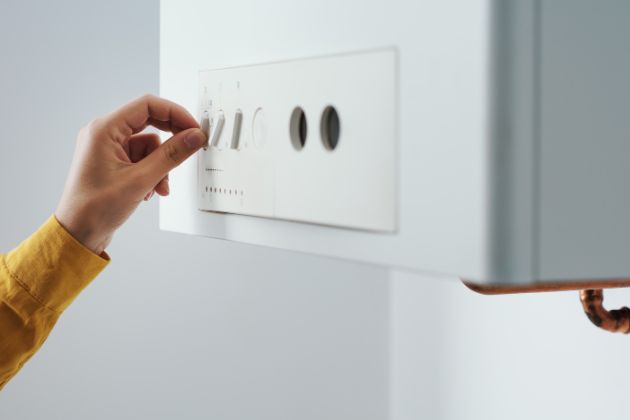
On combi boilers, check the front panel. Some have a heating only or summer mode that limits hot water, and many have an adjustable hot water temperature dial. If this is set very low, the water at the tap may feel lukewarm or cold, especially in winter.
If the controls and mode all look correct, the issue is likely a fault within the boiler or associated valves. You should never remove the boiler casing yourself, but understanding the likely fault helps you explain symptoms clearly and get it fixed more quickly.
On most combi boilers a diverter valve directs hot water either to the radiators or to your taps. If it sticks in the heating position, the radiators work but your hot water does not.
Typical signs include radiators getting hot whenever you run a tap, or the boiler firing up as if it is working normally but the tap water stays cold. A diverter valve repair or replacement is internal work and must be carried out by a Gas Safe engineer.
Hard water can cause the plate heat exchanger inside a combi boiler to scale up over time. This is the component that transfers heat from the boiler water to your domestic hot water.
Symptoms include brief hot water that quickly runs lukewarm or cold, especially when you open more than one tap, and a boiler that seems to cycle on and off. Cleaning or replacing the plate heat exchanger is a job for a professional, but you can help by noting exactly what happens when you open different taps.
Modern boilers use temperature sensors (NTCs) to measure how hot the water is. If the domestic hot water sensor fails, the boiler might not recognise that hot water is needed, or it may shut itself down for safety.
You may see a specific fault code on the boiler display related to temperature, sensor or DHW. The boiler might also start briefly when you open a tap, then cut out. Do not attempt to access sensors behind the casing; report the exact fault code and behaviour to a Gas Safe engineer.
Most combi boilers need a minimum water flow rate to trigger hot water mode. If a tap is only trickling, the boiler may not fire properly, leaving you with cold water even though the heating is fine.
Check other taps and your shower to see if the flow is generally weak or if it only affects one outlet. For combis, also check the boiler’s pressure gauge; if it is below the recommended level (often around 1.0 bar when cold), the boiler may not operate reliably and will need repressurising according to the manufacturer’s instructions or by an engineer.
If your boiler has a digital display, note any flashing lights, numbers or letters. Many manufacturers use specific fault codes for hot water issues, diverter valves or sensors on the domestic hot water side.
Do not try to reset the boiler repeatedly if a fault code returns each time. One reset is fine to see if it was a one off glitch, but a repeating fault means something needs testing and repairing by a professional.
If your system has a separate hot water cylinder, especially an unvented pressurised cylinder, the issue may not be with the boiler alone. Components such as motorised valves, the cylinder thermostat or immersion heater can all affect your hot water.
Unvented cylinders are classed as controlled appliances. Only engineers with the correct qualifications should work on them, including checking safety valves and expansion vessels. If you notice water discharging from the cylinder safety pipe, or no hot water even though the boiler is firing, stop investigating and arrange a qualified engineer visit.
When you call for help, a few details can significantly speed up diagnosis and improve the chances of bringing the right parts first time. Take a moment to gather some basic information before you pick up the phone.
It also helps to know if all taps are affected or just one, and whether your shower is fed directly from the boiler or from a separate pump or mixer valve. The more clearly you can describe the symptoms, the easier it is for an engineer to pinpoint the fault.
Anything involving gas, combustion, or internal boiler components must only be handled by a Gas Safe registered engineer. You should not remove boiler panels, attempt to free a diverter valve, or open an unvented cylinder yourself.
Your safe checklist as a homeowner is limited to control settings, visible pressure readings, and observing symptoms. If those basic checks do not restore hot water, it is time to book a professional repair rather than keep resetting or guessing.
If you have checked your controls, confirmed the boiler is on, and your heating still works but the hot water does not, an internal boiler or cylinder fault is very likely. That is the point to stop investigating and arrange a proper diagnosis and repair visit.
Proper Heat Ltd provides expert boiler repair in Guildford, along with ongoing boiler servicing and new boiler installation for longer term peace of mind. Call Proper Heat Ltd on 07876108958 to book a repair visit and get your hot water running reliably again.


All Right Reserved © Proper Heat Ltd - Company Number 16342110 | Website by BUILT
.svg)