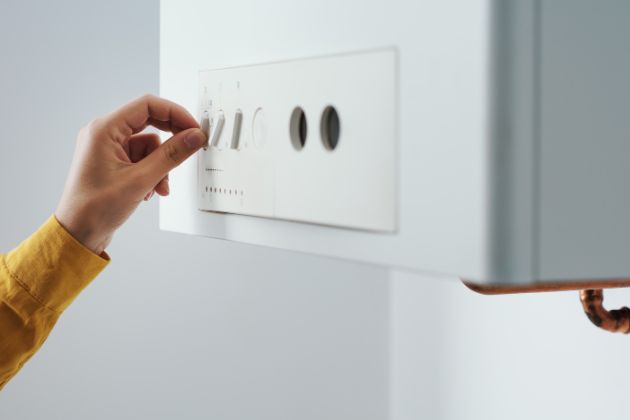
When your boiler suddenly shuts down during a cold snap, a frozen condensate pipe is often the culprit. This pipe drains the acidic water produced during boiler operation, and when it freezes, it blocks the flow, causing your boiler to stop working. Knowing how to spot the signs early, such as gurgling noises, error codes on your boiler, or a lack of heating and hot water, can help you act quickly. Dealing with a frozen condensate pipe safely is essential to avoid damage or injury.
Follow simple steps to thaw it safely, but also understand when it is best to call a professional engineer to prevent further issues and keep your heating system running smoothly.
Most modern condensing boilers create a small amount of acidic water as they run. This liquid is called condensate and needs to be taken away from the boiler to a drain.
The condensate pipe is usually a small white plastic pipe that runs from the bottom of your boiler to an internal or external waste pipe. Where it runs outside, it is particularly vulnerable to freezing during cold snaps.
When the pipe freezes, the boiler’s safety systems usually shut everything down to prevent damage, leaving you without heating or hot water until the blockage is cleared.
You do not need to remove the boiler cover or touch anything inside the boiler to check for a frozen pipe. Instead, look and listen for a few common clues.
The external section of the condensate pipe is usually at a low level on an outside wall, often around the same area as the boiler indoors. In many homes in Godalming, Guildford and Milford, it drops straight down from the boiler position then runs to a drain.
Before attempting anything, check that the boiler is genuinely off and not in the middle of a cycle. If in doubt, turn the boiler off at the controls and wait a few minutes.
Do not remove the boiler casing or attempt to access any internal parts. The checks and steps in this guide all take place on the accessible external plastic pipework only.
A frozen condensate pipe will usually thaw with gentle heat and a bit of patience. Take your time and do not use anything that could crack the pipe or damage the boiler.
Find the small white or grey plastic pipe that leaves the building close to where the boiler is located indoors. Follow it to where it enters a drain or soil pipe, as this lower section is the area most likely to freeze.
Look for visible ice, bulging pipework, or an icy build-up at the pipe’s outlet. If the pipe is high up and out of reach, do not climb or over-stretch; call a professional instead.
Fill a jug or watering can with comfortably warm tap water. It should feel warm to your hand, not scalding.
Slowly pour the warm water along the length of the external pipe, starting from the top and working downwards. Repeat gently several times, giving the ice a chance to melt between pours.
If you prefer not to use water, or you want to help the process along, you can hold a hot water bottle or warm, damp towel against the frozen section of pipe.
Leave it in place for 10 to 15 minutes, checking occasionally. You may hear small cracks or movement in the pipe as the ice breaks up, which is normal if you are using gentle heat.
Once you believe the pipe is clear, go back to the boiler and follow the manufacturer’s instructions to reset it. Often this is a simple press of a reset button or a restart through the controls.
After a minute or two the boiler should begin to operate again. If fault codes remain or the boiler repeatedly locks out, stop and contact a heating engineer.
Using the wrong methods can cause more harm than the original freeze, risking cracked pipes, leaks, or damage to the boiler and property.
In particular, avoid these unsafe approaches:
Anything involving tools, electrical items outside, or access inside the boiler should be left to a competent gas engineer.
Once you have dealt with a frozen condensate pipe, it makes sense to reduce the chances of a repeat during the next cold snap. Some helpful improvements are straightforward, while others need a professional.
For many homes, adding proper weatherproof insulation (lagging) to the outside section of the pipe can make a big difference. Thick, purpose-made foam insulation that is securely taped or clipped in place helps slow down heat loss.
The route and length of the pipe also affect how easily it freezes. External runs should be as short as practical, with as much of the pipe as possible routed internally before it exits the property.
Any changes to the way the pipe is routed, its size, or where it discharges must be carried out by a competent heating engineer to make sure the boiler still meets regulations and works safely.
If your condensate pipe freezes repeatedly, even after you have tried insulation and other simple measures, it is time for a proper assessment. There may be an issue with the pipe size, fall, routing or the way it connects to the drain.
A professional can check the entire condensate system, advise on re-routing, upsizing the pipe, or connecting it differently so it is less exposed to the cold. They can also service the boiler to confirm there are no other underlying faults.
If you are in Godalming, Guildford, Milford or the surrounding Surrey areas and your boiler keeps cutting out with suspected condensate problems, it is sensible to arrange a boiler repair visit. An engineer can usually also advise on ongoing boiler servicing to help prevent other breakdowns and keep your system efficient.
If you are unsure whether the pipe is frozen, cannot safely reach it, or your boiler still will not run after you have tried the safe steps above, it is best to stop and get help. Continuing to reset a boiler that keeps locking out can risk further damage.
For clear advice and professional boiler repair in Godalming, Guildford, Milford and nearby Surrey areas, contact Proper Heat Ltd on 07876108958. A qualified heating engineer can safely diagnose the fault, sort out any condensate pipe issues, and discuss suitable preventative work and boiler servicing to keep your heating reliable through future cold snaps.


All Right Reserved © Proper Heat Ltd - Company Number 16342110 | Website by BUILT
.svg)